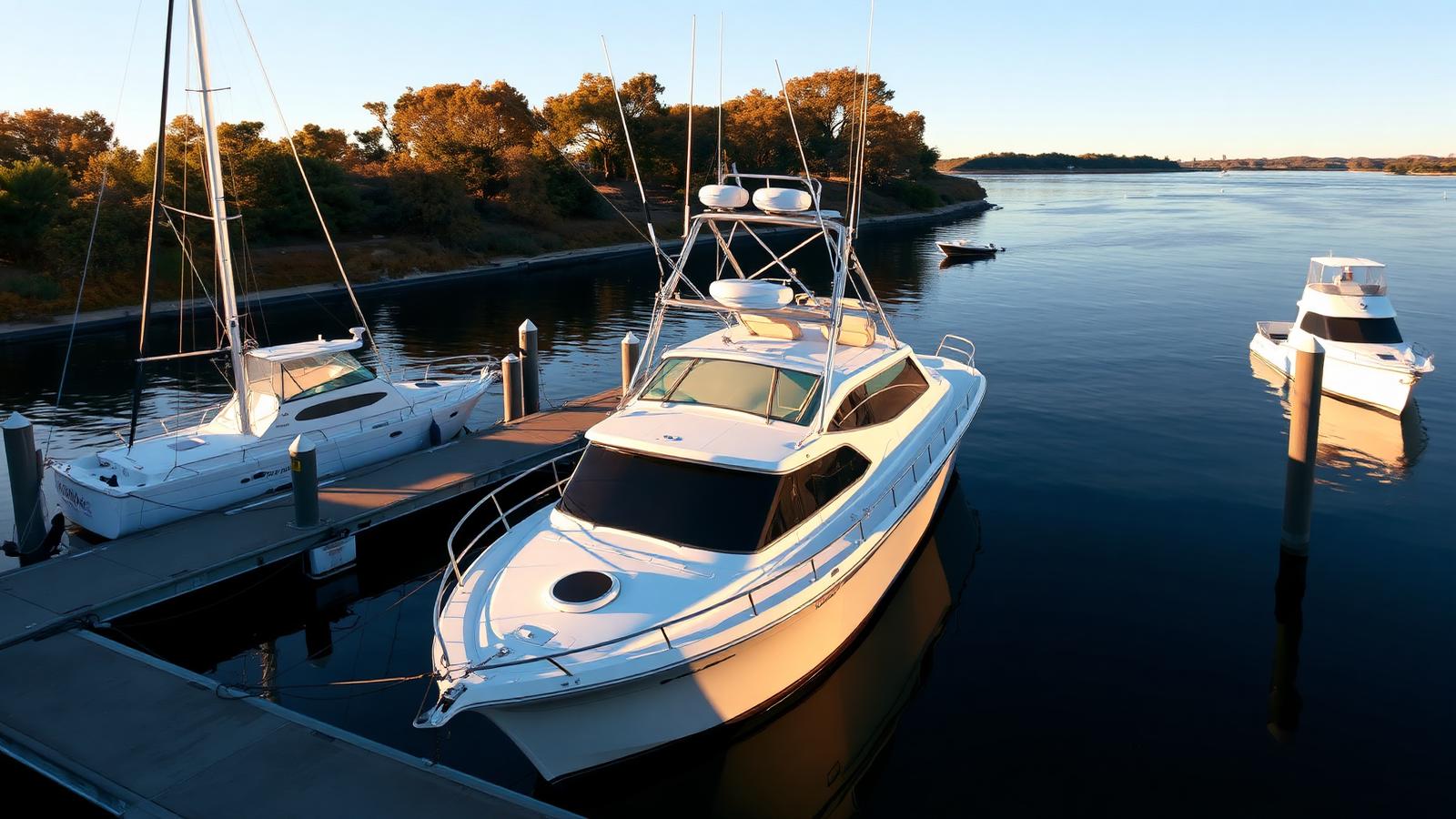
There is a common assumption that a boat in a slip stays roughly as clean as you left it. In Southern California autumn, the opposite is true: a boat that sits often ends up dirtier than one used weekly, because nothing disturbs what settles on it.
Four conditions do most of the work — salt aerosol, airborne dust, overnight moisture, and reduced ventilation. Understanding what each one does makes it obvious why an occasional rinse does not keep up.
Salt air, even without spray
You do not have to take a boat out for it to accumulate salt. Onshore breezes carry fine salt aerosol across a marina continuously, and it settles on every surface. Because it is invisible until it builds, owners tend to underestimate it.
- Salt settles heaviest on the side of the boat facing open water.
- It concentrates around stainless hardware, where it drives the rust streaking you see later.
- It holds moisture against surfaces, which is why salted panels stay damp longer.
- Rinsing without agitation removes some of it, but not what has bonded into texture and seams.
Marina dust and airborne fallout
Marinas sit next to roads, parking lots, working docks, and in some cases active industrial areas. Autumn winds move a lot of fine particulate, and a boat deck is a large flat collector.
- Dust is abrasive. Wiping a dusty surface dry is how a lot of fine scratching happens.
- It mixes with dew overnight into a film that no longer blows off.
- It settles into non-skid texture, where it grinds in underfoot.
- Boats near construction, fuel docks, or high-traffic access see this markedly worse.
Morning moisture and the mildew window
Autumn mornings in LA-area marinas bring heavier condensation than summer. Surfaces are wet for several hours, then dry as the day warms. That repeated damp-dry cycle is what mildew needs, particularly on canvas, in cabins, and under cushions.
- Enclosed cabins with no airflow are the highest-risk area.
- Cushions left flat on a bench trap moisture beneath them.
- Canvas that stays wet into mid-morning develops spotting first at seams.
- Lockers holding damp textiles turn into a source rather than a symptom.
- Prop cushions on edge instead of leaving them flat.
- Crack locker lids where security allows.
- Use a passive vent or dehumidifier in an enclosed cabin.
- Never close up a boat that is still damp inside.

Waterline buildup on a boat that never moves
The waterline is where a stationary boat shows neglect first. A boat sitting still holds one constant contact line with the water surface, and everything floating in that water — oils, organic matter, marina film — concentrates there.
- A stationary boat develops a sharper, darker scum line than one that moves regularly.
- Left long enough, waterline staining migrates from surface deposit into the gelcoat itself.
- Early staining lifts with routine cleaning; established staining often needs correction.
- Underwater hull growth is a separate specialty and is not part of above-waterline detailing.
Covers and canvas: help, with conditions
- Only ever cover a clean, dry boat — a cover over grime holds it in place against the surface.
- Make sure the cover is supported so water sheds rather than pooling.
- Check for chafe points where the cover rubs hardware; those wear through quietly.
- Rinse the cover itself periodically; it collects the same dust and salt everything else does.
- Lift and inspect underneath monthly rather than trusting it blindly.
Why recurring maintenance beats one big reset
For a boat sitting through a quieter season, a modest recurring wash is almost always better value than letting everything accumulate and paying for a heavy reset later. Deposits removed before they bond are cheap; deposits that have etched or embedded are a correction job.

Related service
Maintenance Wash
A recurring cadence that keeps a sitting boat from sliding backwards.
Explore this service
Related service
Complete Wash
The right reset when a boat has already been sitting for a while.
Explore this serviceWhat owners can do now
- Rinse rather than wipe when the boat is dusty.
- Open the boat up for airflow on any visit, even a short one.
- Check the waterline monthly and note whether staining is worsening.
- Store cushions on edge and keep lockers free of damp textiles.
- Set a realistic recurring wash interval instead of an ambitious one you will skip.
When to call a professional
- Waterline staining no longer lifts with normal cleaning.
- Mildew spotting has appeared on canvas or interior surfaces.
- You cannot get to the boat regularly enough to keep up.
- The deck has developed a grey film that rinsing does not clear.
Related location
Boat detailing in Marina del Rey
Marina del Rey coverage, access, and typical local conditions.
See the local guideRelated location
Boat detailing in Redondo Beach
Local context for King Harbor and Redondo Beach.
See the local guideCommon questions
Why does my boat get dirty when I never use it?
Because most marina soiling is environmental, not use-related. Airborne dust, salt aerosol, bird activity, and overnight condensation all accumulate on a boat that never leaves the slip.
Is morning dew actually a problem?
The moisture itself is not. The issue is that it repeatedly re-wets dust and salt already on the surface, which keeps deposits in contact with gelcoat and canvas for hours each day.
How often should a sitting boat be washed in autumn?
A longer interval than in summer still beats stopping entirely. The right cadence depends on the marina, whether the boat is covered, and how exposed the slip is. We suggest one after seeing photos.
Does a cover eliminate the need for washing?
No. Covers reduce direct fallout and UV, but they trap moisture underneath if the boat was not clean and dry when covered, and the cover itself accumulates grime.
Where this fits in our work
Related services
Related locations
Last updated